Problems & fixes
Why Is My Epoxy Resin Bendy? Causes and Solutions
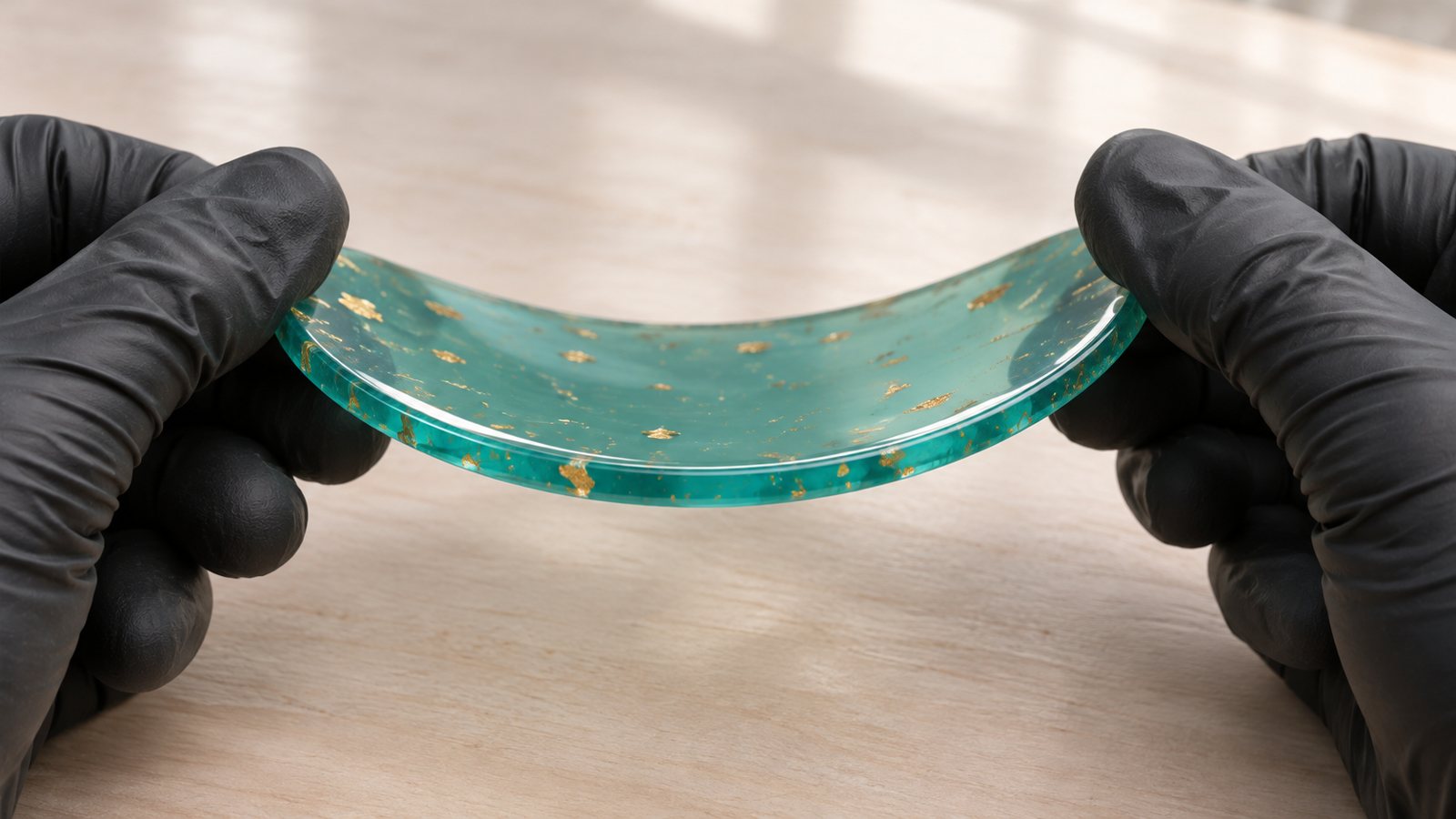
Epoxy resin is often associated with a hard, durable finish. However, some resin pieces remain slightly flexible even after curing, while others bend because the curing process has not been completed properly.
Understanding the difference is essential. Flexible resin does not always indicate a curing failure. The resin formulation, thickness of the piece, curing conditions, and accuracy of mixing can all influence the final result.
This guide explains why epoxy resin may remain flexible, how to identify the cause, and what can be done to correct or prevent the problem.
Is Flexible Epoxy Resin Always a Problem?
Not necessarily. Different epoxy formulations are designed to achieve different mechanical properties.
Some resins cure into relatively rigid materials, while others retain a degree of flexibility. Even a properly cured resin may bend when cast into a thin, unsupported shape.
The following characteristics can help distinguish normal flexibility from a potential curing problem.
| Normal flexibility | Possible curing problem |
|---|---|
| Surface is dry and non-tacky | Surface feels sticky or soft |
| Piece bends slightly without damage | Piece deforms easily |
| Resin has reached its specified cure time | Resin remains soft beyond the cure time |
| Behaviour is consistent with the product’s properties | Hardness is noticeably below expectations |
Important: A dry, non-sticky surface does not guarantee complete curing. Always consider the manufacturer’s specifications and recommended curing conditions.
Why Does Epoxy Resin Remain Flexible?
1. The Resin Formulation
Not all epoxy resins are designed to achieve the same rigidity.
Some formulations are intended for thin coatings or applications where limited flexibility is desirable. Others are formulated to produce harder, more rigid castings.
The final mechanical properties depend on the resin’s chemical formulation and curing system. When choosing a product, review its Technical Data Sheet (TDS) for relevant properties, including hardness, recommended applications, and curing requirements.
Tip: Shore hardness measures resistance to indentation, but it does not directly indicate how much a finished resin piece will bend. Flexibility also depends on thickness, shape, and material stiffness.
2. Insufficient Curing Time
Epoxy resin gradually develops its final properties through a chemical reaction between the resin and hardener.
A piece may become firm enough to demould before reaching its full mechanical strength and hardness.
Handling or bending the artwork too early may cause temporary or permanent deformation.
What to do
Allow the piece to complete the manufacturer’s specified curing period under the recommended environmental conditions.
Avoid applying pressure, bending, sanding, or placing heavy objects on the resin before it has developed sufficient hardness.
Curing times vary significantly between formulations. Do not assume that every epoxy reaches full hardness within a fixed number of days.
3. Thin or Unsupported Resin Pieces
Thin resin castings are generally easier to bend than thicker pieces made from the same material. For example, a thin resin bookmark may flex noticeably, while a thicker coaster made from the same epoxy may appear much more rigid.
This difference does not necessarily indicate incomplete curing.
What to do
If the resin has cured correctly but the finished piece is too flexible for its intended use, consider:
-
Selecting a more rigid casting resin.
-
Increasing the thickness within the manufacturer’s permitted limits.
-
Incorporating a suitable rigid backing or support.
Adding another layer may increase stiffness, but the result depends on the resin formulation, adhesion between layers, and final dimensions.
4. Incorrect Resin-to-Hardener Ratio
Epoxy resin requires a specific proportion of resin and hardener to achieve the intended chemical reaction. Adding too much or too little of either component can interfere with curing, leaving the finished material softer or more flexible than expected.
The correct ratio may be specified by weight or volume, and these measurements are not necessarily interchangeable.
What to do
Always measure both components according to the manufacturer’s instructions.
Do not add extra hardener in an attempt to produce a harder or faster-curing result. An incorrect ratio can compromise the final properties.
For detailed instructions, see our article How to Mix Epoxy Resin and Hardener.
5. Inadequate Mixing
Even when the correct quantities are measured, insufficient mixing can prevent the components from reacting uniformly.
Poorly blended resin may develop areas with different levels of hardness, including soft, sticky, or unusually flexible sections.
What to do
Mix for the manufacturer’s recommended duration, regularly scraping the sides, bottom, and corners of the container during mixing.
Avoid vigorous stirring, which can introduce excessive bubbles.
If the resin has already cured improperly because of inadequate mixing, additional waiting time may not resolve the problem.
6. Excessive or Incompatible Colourants
Pigments, dyes, alcohol inks, and other additives can influence the curing behaviour of epoxy resin. Adding excessive colourant or using materials not intended for epoxy may interfere with the curing reaction or alter the final mechanical properties.
Some liquid colourants contain solvents or other ingredients that may affect compatibility.
What to do
Use colourants suitable for the specific epoxy system and remain within the manufacturer’s recommended addition limits. There is no universal percentage that applies to every resin and colourant combination.
For unfamiliar additives, test a small batch before using them in a larger project.
7. Unsuitable Temperature and Humidity
Environmental conditions can affect how epoxy resin cures. Low temperatures may slow the curing reaction, delaying the development of hardness. Excessively high temperatures can shorten working time and increase the risk of overheating. Humidity may also contribute to surface defects in susceptible epoxy formulations, although a flexible finished piece should not automatically be attributed to high humidity.
What to do
Maintain the temperature and humidity specified by the manufacturer throughout the required curing period.
Avoid placing resin near direct heat sources or attempting to accelerate curing with uncontrolled heat.
How to Fix Flexible Epoxy Resin
The appropriate solution depends on whether the resin is still curing, has cured correctly but remains naturally flexible, or has failed to cure properly.
| Condition | Recommended action |
|---|---|
| Resin is still within its curing period | Allow more time under suitable conditions |
| Fully cured but naturally flexible | Consider a rigid support or a different resin |
| Thin, unsupported casting | Assess whether additional thickness or backing is suitable |
| Soft due to incorrect measuring or mixing | Remove improperly cured material or discard the piece |
| Sticky or unusually soft after full cure time | Treat as a potential curing failure |
If the Resin Needs More Time
Leave the artwork undisturbed in an environment that meets the manufacturer’s curing requirements.
If the resin was exposed to temperatures below the recommended range, restoring suitable conditions may allow curing to continue, provided the mixture was prepared correctly.
Do not assume that additional curing time will correct an incorrect mixing ratio or severe mixing error.
If the Resin Is Fully Cured but Naturally Flexible
First, determine whether the flexibility is acceptable for the intended application.
For decorative pieces that do not require structural rigidity, slight flexibility may not be a problem.
If greater stiffness is necessary, a compatible rigid backing may be appropriate. Alternatively, use a more rigid epoxy formulation for future projects.
If the Resin Has Failed to Cure Properly
Resin that remains persistently soft, tacky, or improperly cured because of incorrect proportions, inadequate mixing, or incompatible additives cannot reliably be repaired simply by adding another layer.
A fresh coat may harden on the surface while leaving improperly cured material underneath.
Where practical, remove the affected material using appropriate protective equipment and the manufacturer’s recommended procedures. If the defective material cannot be safely removed, discarding the piece may be the better option.
Important: Avoid sanding uncured or tacky epoxy. Follow the Safety Data Sheet (SDS) for safe handling, cleanup, and disposal of uncured components.
How to Prevent Flexible Resin
The following precautions can help achieve consistent results:
-
Choose the right resin. Select a formulation with mechanical properties suitable for the intended project.
-
Follow the mixing ratio. Measure resin and hardener accurately using the specified weight or volume method.
-
Mix thoroughly. Follow the recommended mixing procedure and duration.
-
Control colourant quantities. Use compatible additives within the manufacturer’s stated limits.
-
Maintain suitable curing conditions. Follow the recommended temperature and humidity requirements.
-
Allow sufficient curing time. Do not judge final hardness immediately after demoulding.
-
Consider the finished thickness. Thin, unsupported pieces may remain flexible even when correctly cured.
Final Thoughts
Flexible epoxy resin is not always a sign of failure. Some formulations naturally retain flexibility, and thin castings may bend even after reaching their full cure.
The important distinction is whether the resin has developed the properties expected for that particular product.
If flexibility results from insufficient curing time, allowing the resin to cure under suitable conditions may resolve the issue. However, incorrect measuring, inadequate mixing, or incompatible additives can cause curing failures that additional time or another coating cannot reliably correct.
Choosing the appropriate resin, following the manufacturer’s instructions, and understanding how thickness affects stiffness are the most effective ways to prevent unwanted flexibility.