
Workspace, weather & storage
How Hot Weather Affects Epoxy Resin
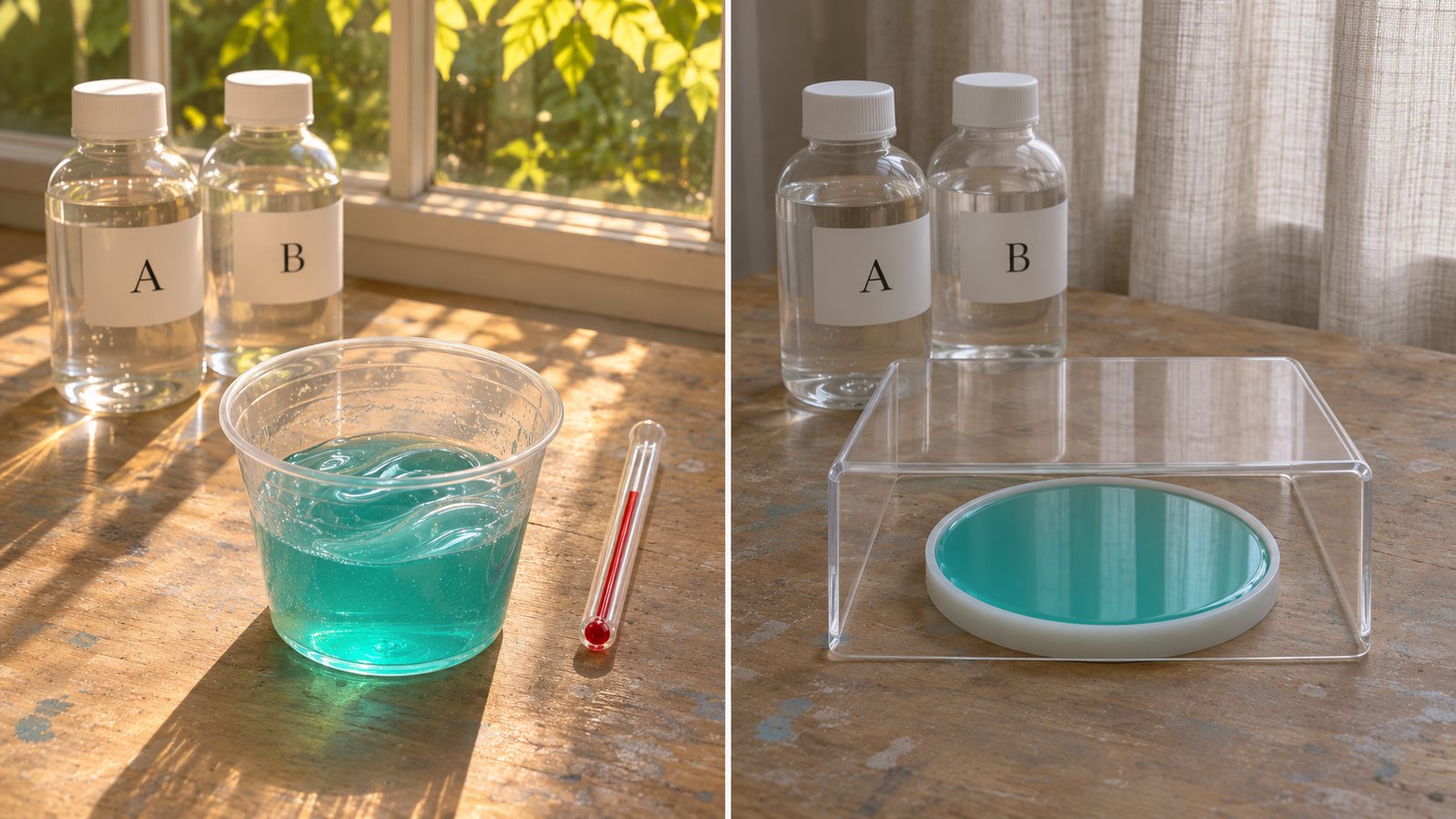
Warm conditions can help epoxy resin flow smoothly and cure efficiently. However, excessive heat can accelerate the curing reaction, shorten working time, and cause unwanted surface imperfections.
High temperatures can also affect resin during storage and may damage finished artwork, even after it has fully cured.
Understanding how heat influences epoxy resin will help you maintain better control over mixing, pouring, and curing, particularly during the summer months.
How Does Hot Weather Affect Epoxy Resin?
Epoxy resin cures through an exothermic chemical reaction, meaning that heat is released when the resin and hardener react.
As the temperature increases, the curing reaction generally accelerates. Although moderate warmth can improve resin flow, excessive heat may cause several problems:
-
Shorter working time: The mixture thickens sooner, leaving less time for pouring and adjustments.
-
Rapid heat build-up: Large quantities of mixed resin may become excessively hot.
-
Premature gelation: Resin may begin to set before pouring is complete.
-
Surface imperfections: Rapid curing or temperature fluctuations may contribute to uneven surfaces.
-
Reduced control over decorative effects: Faster thickening can change pigment movement and pouring patterns.
The severity of these effects depends on the resin formulation, ambient temperature, batch size, and pouring depth.
1. Maintain a Suitable Workspace Temperature
Every epoxy system has a recommended application temperature range, which should be stated in its Technical Data Sheet (TDS).
Some art-coating resins are designed to perform well at approximately 20–25°C, while others permit higher application temperatures.
Working above the recommended range may significantly shorten pot life and make the resin more difficult to control.
Air conditioning can help maintain suitable conditions during hot weather. Ideally, stabilise the room temperature before mixing and keep it within the recommended range throughout curing.
Tip: Avoid pouring resin in a room that is expected to become considerably hotter later in the day. Plan your work around stable indoor conditions rather than outdoor temperatures alone.
2. Keep Resin and Hardener at the Correct Temperature
The temperature of the resin components is just as important as the temperature of the workspace.
Bottles left in a hot vehicle, exposed to direct sunlight, or stored in an uncooled room may become significantly warmer than the surrounding workspace.
Mixing already-warm components can accelerate the reaction immediately.
Before starting:
-
Store resin and hardener in a shaded, temperature-controlled location.
-
Allow overheated bottles to return gradually to the manufacturer’s recommended application temperature.
-
Check that the containers and their contents are no longer excessively warm.
-
Prepare all materials before mixing.
Avoid rapidly cooling resin with ice or exposing containers to extreme temperature changes unless the manufacturer specifically permits the method.
3. Be Aware of Heat Build-Up in Mixing Containers
When epoxy resin and hardener are combined, they undergo a chemical reaction that generates heat. In a large or deep mixing container, this heat may accumulate faster than it can escape.
Under hot conditions, the mixture may thicken rapidly, become extremely hot, smoke, or undergo uncontrolled curing.
To reduce the risk:
-
Mix quantities within the manufacturer’s recommended batch limits.
-
Use appropriate mixing containers.
-
Avoid leaving large volumes of mixed resin standing unnecessarily.
-
Transfer the mixture promptly to its intended application when the product instructions permit.
-
Never attempt to slow an overheating reaction by adding extra resin, hardener, or solvent.
Important: If mixed resin begins overheating unexpectedly, stop handling it and follow the manufacturer’s safety instructions. Do not touch an overheated container with bare hands or attempt to contain the reaction in a sealed vessel.
4. Consider the Temperature of the Artwork and Mould
Even when the workspace is comfortable, the surface receiving the resin may still be hot. Metal trays, stone, wood panels, and silicone moulds can retain heat after exposure to sunlight or warm storage conditions. Pouring resin onto an overheated surface may accelerate curing locally, reduce working time, or affect the finished appearance.
Allow the substrate and mould to reach a suitable, stable temperature before applying resin.
This is particularly important for large projects and surfaces that have been stored outdoors.
5. Control Humidity During Hot Weather
Hot weather is often accompanied by elevated humidity, especially in coastal environments.
Moisture can interfere with certain epoxy systems and contribute to:
-
Amine blush, which may appear as a waxy or greasy surface film.
-
Cloudiness or loss of transparency.
-
Surface irregularities.
-
Reduced adhesion between layers if contamination remains.
Many resin applications benefit from moderate relative humidity, but acceptable limits vary by formulation.
Use a hygrometer to monitor conditions and follow the manufacturer’s recommendations.
Air conditioning or a dehumidifier may help control moisture levels. Avoid introducing water into the resin, mixing containers, pigments, or decorative materials.
Tip: Humidity and temperature should be controlled together. A comfortable room temperature does not necessarily mean that moisture levels are suitable for resin work.
6. Keep Temperature Stable During Curing
Sudden changes in temperature may affect resin flow and curing behaviour.
For example, an artwork placed near a sunny window may become considerably warmer during the day and cool rapidly after sunset.
Depending on the formulation and curing stage, these changes may contribute to uneven surfaces, ripples, dimples, or other defects.
Maintain stable conditions throughout the manufacturer’s recommended initial curing period.
Avoid placing freshly poured artwork near windows, direct air-conditioning drafts, heating equipment, or other sources of fluctuating temperature.
7. Adjust Your Working Method in Hot Conditions
When the room is warmer, the resin may provide less working time than expected.
To maintain better control:
-
Organise tools, pigments, and decorative materials before mixing.
-
Prepare the mould and level the work surface in advance.
-
Measure only the quantity needed for the immediate application.
-
Work within the resin’s specified pot life and pouring limits.
-
Avoid unnecessary delays after mixing.
For complex techniques requiring extended pigment movement or detailed manipulation, consider using a resin formulated with a longer working time.
Do not attempt to extend working time by changing the mixing ratio.
8. How Does Hot Weather Affect Fully Cured Resin?
Fully cured epoxy resin can also be affected by elevated temperatures.
Epoxy materials have formulation-dependent thermal properties, including a glass transition temperature (Tg), above which the material may become less rigid.
When exposed to sufficient heat, some cured resin pieces may temporarily soften or become more flexible.
Possible consequences include:
-
Bending or warping.
-
Surface indentations.
-
Permanent deformation under sustained pressure.
-
Increased vulnerability to scratches or handling damage.
Some pieces may regain rigidity after cooling, but permanent distortion is possible.
Heat resistance varies significantly between epoxy products, and full curing does not make resin heatproof.
9. Protect Finished Resin Artwork from Heat
To minimise heat-related damage:
-
Avoid prolonged exposure to direct sunlight.
-
Never leave resin artwork inside a parked vehicle during hot weather.
-
Do not stack or place heavy objects on resin pieces exposed to elevated temperatures.
-
Protect artwork during outdoor exhibitions and transportation.
-
Use products with suitable heat-resistance specifications for functional applications.
Direct sunlight can also accelerate yellowing through ultraviolet exposure, even when the resin contains UV stabilisers.
10. Store Epoxy Resin Properly in Hot Weather
Prolonged exposure to excessive heat may affect the storage stability of resin and hardener.
To protect unused materials:
-
Keep containers tightly closed.
-
Store them in a cool, dry, shaded location within the manufacturer’s recommended temperature range.
-
Avoid garages, vehicles, and other areas subject to extreme heat.
-
Keep resin and hardener in their original containers.
-
Check shelf-life information before using older materials.
If a product has been exposed to unusually high temperatures, consult the manufacturer before use.
Final Thoughts
Hot weather can improve resin flow under controlled conditions, but excessive heat reduces working time and increases the risk of rapid curing, overheating, and surface defects.
For consistent results, monitor the temperature of the workspace, resin components, mould, and artwork. Maintain suitable humidity and stable curing conditions and always follow the product’s technical instructions.
The key is controlled warmth, not excessive heat.
*Tg (glass transition temperature)